

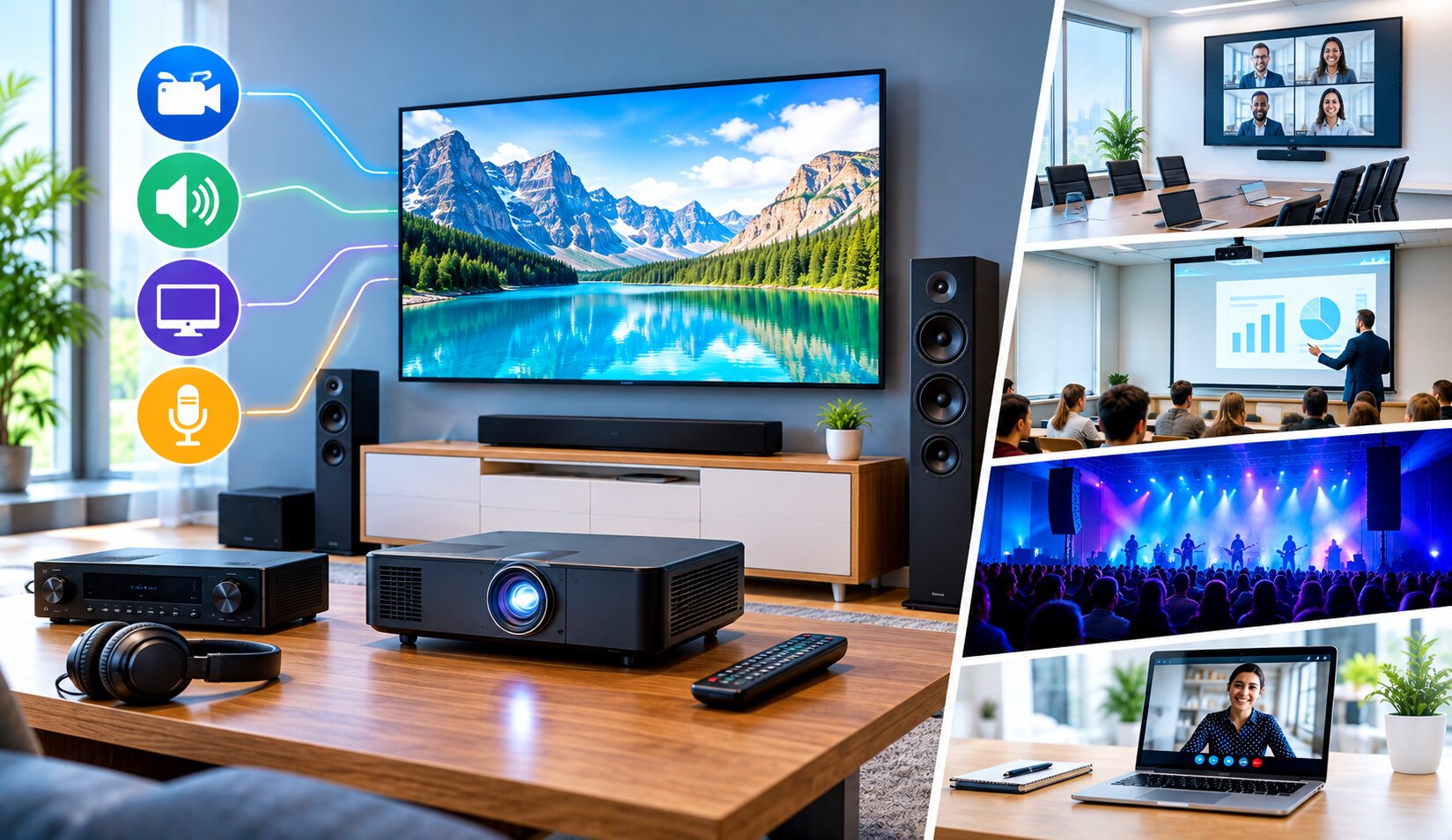
Walk into almost any modern conference room, classroom, or event space, and A/V equipment is quietly doing the work that makes the whole experience possible. Most people only notice it when something breaks. Here’s what A/V actually covers, the equipment involved, and where it shows up across business and everyday life.
Key Takeaways
- A/V stands for Audio/Video, referring to technology that captures, transmits, or displays sound and visual content together.
- Common A/V equipment includes microphones, speakers, projectors, displays, and video conferencing systems.
- A/V systems show up in conference rooms, classrooms, live events, and home entertainment setups.
- Modern A/V increasingly integrates with network infrastructure, not standalone hardware alone.
- Reliable A/V setups depend on solid underlying infrastructure, including proper network cabling and power distribution.
What Does A/V Stand For?
A/V stands for Audio/Video, a broad term covering any technology that captures, processes, transmits, or displays sound and visual content, often together as a combined experience. This spans everything from a simple conference room speakerphone to a fully integrated live event production system with multiple cameras, microphones, and displays working in sync. The A/V industry has grown significantly alongside the rise of hybrid work and video conferencing, which has pushed A/V technology well beyond its traditional home in theaters and broadcast studios. Related concepts include video conferencing, digital signage, audio mixing, and AV over IP.
In simple terms, A/V is the collection of technology that lets people see and hear content clearly, whether that’s a business presentation, a classroom lecture, a concert, or a movie playing at home.
Common A/V Equipment Types
A/V systems combine several categories of equipment, each handling a specific part of the overall audio and visual experience.
- Microphones and audio capture — Devices that capture sound, ranging from simple handheld mics to ceiling-mounted arrays in conference rooms.
- Speakers and amplifiers — Equipment that outputs sound at appropriate volume and clarity for the space, whether that’s a small huddle room or a large auditorium.
- Displays and projectors — Screens and projection systems that show visual content, from a single conference room monitor to a multi-screen video wall.
- Cameras and video capture — Equipment that records or streams live video, increasingly common in hybrid meeting rooms and live-streamed events.
- Control systems — Interfaces that let users manage an entire A/V setup, adjusting volume, switching inputs, or controlling lighting from a single touchpanel.
Where A/V Systems Show Up
Business and conference rooms
Modern meeting spaces rely heavily on A/V for video conferencing, presentations, and hybrid collaboration between in-person and remote participants.
Education
Classrooms use A/V equipment for lecture capture, remote learning, and interactive displays that support both in-person and distance education.
Live events and entertainment
Concerts, conferences, and theatrical productions depend on complex A/V systems, often involving multiple synchronized cameras, microphones, and display outputs.
Home entertainment
Home theater setups, smart TVs, and streaming systems represent the consumer side of A/V technology, bringing many of the same principles into everyday households.
A/V Terminology: Quick Reference
| Term | Meaning |
|---|---|
| AV over IP | Transmitting audio/video signals over a standard network instead of dedicated AV cabling |
| Digital signage | Networked displays showing dynamic content, common in retail and corporate settings |
| Latency | The delay between capturing audio/video and it reaching the viewer, critical for live events |
| Room scheduling integration | A/V systems tied into calendar and booking software for automated meeting setup |
Why A/V Matters More Than It Used To
“A/V used to be a specialty concern for theaters and broadcast studios. Now it’s core infrastructure for how businesses actually operate day to day, especially with hybrid work becoming permanent for so many organizations.” — Carlos Mendez, Enterprise A/V Systems Integrator, Corporate Technology Solutions Group, 2025.
The shift toward hybrid work has made reliable A/V a business necessity rather than a nice-to-have. A poorly functioning conference room camera or a dropped audio connection now directly disrupts real work, not just a special event. This growing dependence on A/V also means it increasingly relies on solid underlying network infrastructure, since modern AV over IP systems run through the same cabling and network closets, like an IDF, that carry regular data traffic.
Frequently Asked Questions
What does A/V stand for?
A/V stands for Audio/Video, referring to technology involved in capturing, processing, transmitting, or displaying sound and visual content.
What’s the difference between A/V and IT?
A/V traditionally focused on specialized audio and video equipment, while IT focused on computing and networking. The line has blurred significantly as A/V systems increasingly run over standard IP networks.
Do small businesses need dedicated A/V systems?
It depends on needs. Even small businesses benefit from basic A/V setups for video conferencing, though the complexity and investment level should match actual usage patterns rather than matching what larger enterprises deploy.
What is AV over IP?
AV over IP transmits audio and video signals over a standard computer network instead of dedicated, proprietary A/V cabling, which simplifies installation and allows A/V systems to share existing network infrastructure.
How often should A/V equipment be updated? This varies by equipment type and usage intensity, but many organizations reassess conference room A/V every few years, since video conferencing standards and resolution expectations continue to evolve steadily.
Conclusion
A/V technology has quietly grown from a specialty concern into core infrastructure that businesses, schools, and event spaces depend on every day. Whether it’s a conference room video call, a classroom lecture, or a live-streamed event, the underlying combination of microphones, displays, cameras, and control systems works best when it’s reliable and largely invisible to the people using it. As A/V increasingly runs over standard network infrastructure, understanding both the equipment and the network it depends on matters more than ever.
For related reading, see our guides on what an IDF is, what a PDU is, and wide area networks.