

Millions of drivers unlock and start their cars every day without ever pulling out a key, thanks to passive keyless entry. It’s convenient — but that same convenience has created a real, well-documented security gap that thieves actively exploit. Here’s exactly how the technology works and what you can do to stay protected.
Key Takeaways
- Passive keyless entry (PKE) unlocks and starts a car automatically when the key fob is nearby, with no button press required
- It works through low-frequency signals that detect the fob’s proximity, then a high-frequency response that authenticates it
- The main security risk is a “relay attack,” where thieves use signal-boosting devices to trick the car into thinking the fob is nearby
- Simple defenses — like signal-blocking pouches — can significantly reduce your risk
- Newer systems using ultra-wideband (UWB) technology are more resistant to relay attacks than older RF-based systems
What Is Passive Keyless Entry?
Passive keyless entry (PKE) is a car access system that automatically unlocks the doors and enables the engine start button when the key fob is within a short range of the vehicle, without the driver needing to press any button on the fob. This is different from traditional remote keyless entry, which still requires physically pressing a button to lock or unlock the car — passive entry happens automatically just by walking up to the vehicle with the fob in your pocket or bag.
The “passive” in passive keyless entry refers to this lack of required action from the driver. The car and fob communicate automatically in the background, constantly checking whether the correct key is nearby.
How Does Passive Keyless Entry Work?
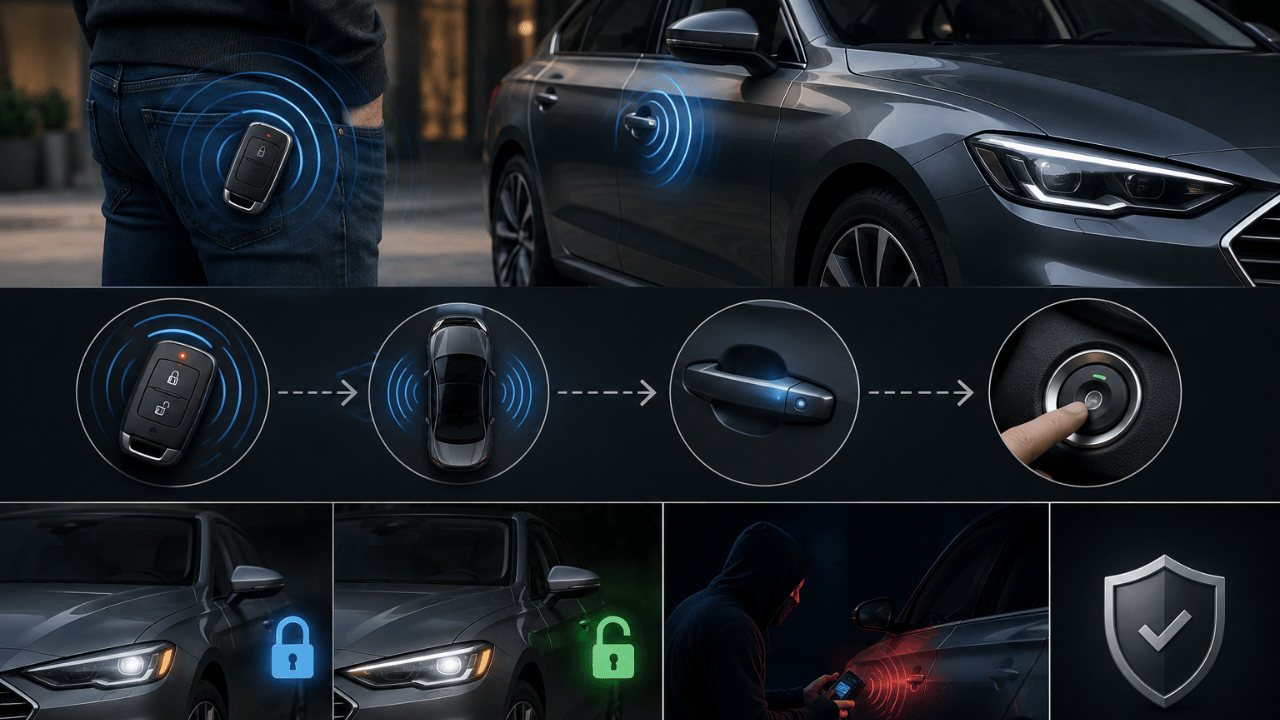
Passive keyless entry works through a two-way radio signal exchange: the car periodically emits a low-frequency signal searching for its paired key fob, and when the fob is close enough to receive it, the fob responds with a high-frequency signal that authenticates it and unlocks the vehicle. This entire exchange typically happens within a range of about one to two meters and completes in a fraction of a second.
Here’s the basic sequence:
- The car sends out a low-frequency “wake-up” signal, usually from antennas built into the door handles.
- The key fob, if within range, receives that signal and automatically wakes up to respond.
- The fob sends back an encrypted high-frequency response confirming it’s the correct, authorized key.
- The car verifies the response and unlocks the doors — and, once inside, allows the engine to start via a push-button ignition.
Is Passive Keyless Entry Secure?
Passive keyless entry is convenient but carries a well-documented security weakness: it can be exploited through a “relay attack,” where thieves use signal-boosting equipment to trick a car into thinking its key fob is nearby, even when the actual fob is far away — often still inside the owner’s home. This isn’t a theoretical risk; security researchers and law enforcement agencies have documented relay-attack car thefts for years, and the equipment needed to carry one out has become cheaper and more accessible over time.
How a Relay Attack Works
In a typical relay attack, one thief stands near the house with a device that captures the weak signal from the key fob inside, while a second thief stands near the car with a receiver that “relays” that captured signal to the vehicle. The car interprets the relayed signal as if the real key were right next to it, unlocking the doors and allowing the engine to start — all without the fob ever leaving the house.
How to Protect Your Car from Relay Attacks
- Store your key fob in a signal-blocking (Faraday) pouch. This is the single most effective defense, since it physically blocks the fob’s signal from being captured in the first place.
- Keep your fob away from doors and windows. Storing your key fob deeper inside your home reduces the chance that a relay device outside can pick up its signal.
- Check if your fob has a sleep mode. Some newer key fobs include a motion sensor that puts them to sleep after a period of inactivity, stopping them from responding to relay signals.
- Ask your dealer about ultra-wideband (UWB) key systems. UWB technology measures signal timing far more precisely than older RF-based systems, making distance spoofing significantly harder to pull off.
- Consider a steering wheel lock as a backup. Even if a thief unlocks and starts your car, a visible physical lock adds a deterrent that many opportunistic thieves won’t bother working around.
- Review your car’s companion app for location alerts. Many modern vehicles offer app-based alerts if the car is started or moved unexpectedly, giving you a chance to react quickly.
Passive Keyless Entry vs. Remote Keyless Entry
The core difference between passive keyless entry and remote keyless entry is user action: passive entry unlocks the car automatically as you approach, while remote entry still requires pressing a button on the fob to lock or unlock the doors. Remote keyless entry is generally considered somewhat less vulnerable to relay attacks, simply because it doesn’t constantly broadcast a signal that can be captured without any driver interaction at all.
Frequently Asked Questions
A regular key fob requires you to press a button to lock or unlock the car, while passive keyless entry unlocks automatically when the fob is nearby, with no button press required.
Yes — relay attacks are a documented and ongoing method of vehicle theft, where thieves use signal-boosting devices to trick a car into detecting the key fob as nearby even when it’s actually far away, such as inside the owner’s home.
Yes, a properly functioning Faraday (signal-blocking) pouch prevents the key fob’s signal from being detected or captured at all, making it one of the most reliable and low-cost defenses against relay attacks.
Most passive keyless entry systems detect the key fob within roughly one to two meters of the vehicle, though relay attack equipment can effectively extend that range by capturing and rebroadcasting the signal over much greater distances.
Generally yes — many newer vehicles use ultra-wideband (UWB) technology or added motion-sensor sleep modes in the key fob, both of which make relay attacks significantly harder to execute than on older RF-only systems.
Many vehicles allow you to disable passive entry through the car’s settings menu, which removes the automatic unlock convenience but also eliminates the specific relay attack risk tied to that feature.
Final Thoughts
Passive keyless entry trades a small security trade-off for everyday convenience, and for most drivers, that trade-off is manageable with a few simple precautions. A signal-blocking pouch costs very little compared to the cost of a stolen vehicle, making it one of the easiest security upgrades most car owners can make today.
For more on protecting yourself from everyday tech-enabled theft, check out our related guides on What Is a Keylogger? and What Is Identity Theft? How to Prevent It in 2026.