

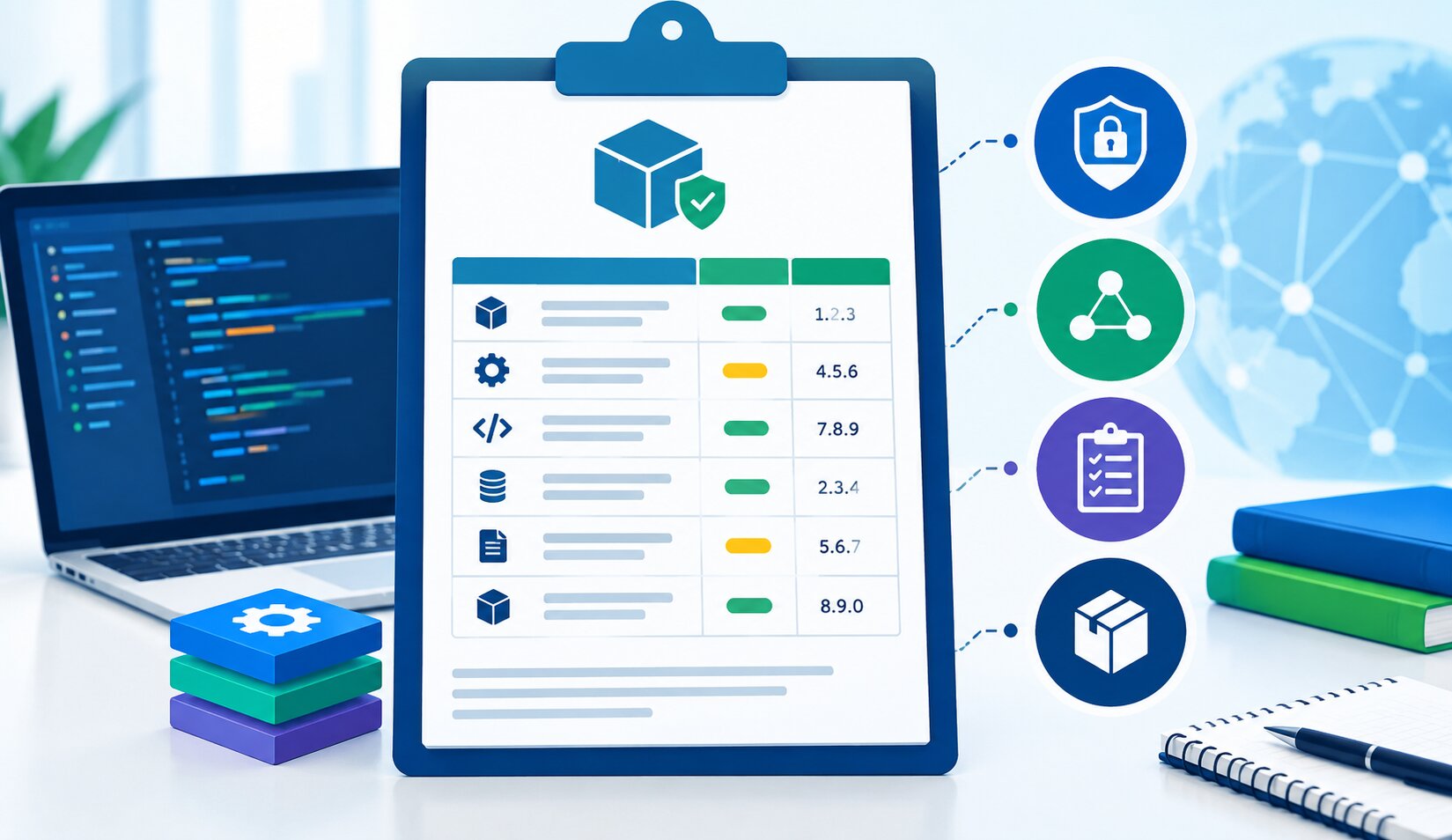
A single vulnerable open-source library, buried three dependencies deep, can quietly expose an entire application. Without a clear list of what’s actually inside your software, finding that vulnerability after the fact turns into a scramble. An SBOM prevents that scramble. Here’s what it is, why regulators and customers increasingly require it, and a free template to help you build your first one.
Key Takeaways
- An SBOM (Software Bill of Materials) is a complete inventory of every component inside a piece of software.
- It lists direct and transitive dependencies, licenses, and versions for each component.
- SBOMs help teams respond faster to newly discovered vulnerabilities, like a critical CVE in a widely used library.
- U.S. federal guidance and growing customer requirements have made SBOMs increasingly standard practice.
- SBOMs work alongside broader security practices like threat intelligence monitoring and strong cybersecurity fundamentals.
What Is an SBOM?
An SBOM, or Software Bill of Materials, is a complete, formal inventory of every component that makes up a piece of software, including direct dependencies, transitive dependencies, licenses, and version numbers. Think of it like an ingredient label for software. Just as a food label lists every ingredient, an SBOM lists every component a piece of software actually contains, down to the open-source libraries buried deep inside its dependency tree. U.S. federal guidance has pushed SBOM adoption forward significantly in recent years, since agencies and their vendors increasingly require one as part of standard security practice. Related concepts include dependency mapping, CVE (Common Vulnerabilities and Exposures) tracking, and supply chain security.
Why SBOMs Matter
Faster vulnerability response
When a major vulnerability gets disclosed in a widely used library, an SBOM lets a team instantly check whether that library exists anywhere in their software stack, instead of manually searching through code.
Supply chain transparency
Modern software often includes dozens or hundreds of third-party components. An SBOM makes that supply chain visible, which matters both for security and for understanding license obligations.
Regulatory and customer requirements
Government contracts and an increasing number of enterprise customers now require an SBOM before purchasing or deploying software, making it a practical business requirement, not just a security nice-to-have.
Reduced audit time
Having a maintained SBOM significantly speeds up security audits and compliance reviews, since the component inventory already exists instead of needing to be reconstructed from scratch.
What Belongs in an SBOM
A complete SBOM captures specific data points for every component, not just a simple list of names.
- Component name and version — The exact identity and version of each software component included.
- Supplier or vendor — Who created or maintains the component, which matters for accountability and support.
- License type — The license governing each component, since license compliance issues can create real legal risk.
- Dependency type — Whether the component is a direct dependency your team chose, or a transitive dependency pulled in indirectly.
- Known vulnerabilities (CVEs) — Any documented vulnerabilities associated with the specific component version in use.
- Component hash — A cryptographic hash confirming the exact version and integrity of the component.
Free SBOM Template
Use this starter template to begin building your first SBOM. Copy the structure below into a spreadsheet, or download the CSV version linked at the end of this guide.
| Component Name | Version | Supplier/Vendor | License Type | Dependency Type | Source | Known CVEs | Last Updated |
|---|---|---|---|---|---|---|---|
| openssl | 3.0.12 | OpenSSL Project | Apache 2.0 | Direct | apt/OS package | CVE-2023-XXXX | 2026-01-15 |
| lodash | 4.17.21 | Lodash Team | MIT | Transitive | npm | — | 2025-11-02 |
This basic structure covers the fields most SBOM standards, including SPDX and CycloneDX, expect as a baseline. Larger organizations typically automate this process rather than maintaining it manually, but this template works well as a starting point or for smaller projects.
SBOM Formats: SPDX vs. CycloneDX
| Feature | SPDX | CycloneDX |
|---|---|---|
| Origin | Linux Foundation project | OWASP project |
| Primary focus | License compliance and component identification | Security-focused, vulnerability tracking |
| Common use case | Broad software supply chain documentation | Application security and DevSecOps pipelines |
| Format support | JSON, YAML, RDF, spreadsheet | JSON, XML |
Why This Matters for Security Teams
“The organizations that get hit hardest by a new critical vulnerability are almost always the ones that don’t know where that component lives in their stack. An SBOM turns a days-long manual search into a five-minute query.” — Jordan Reyes, Application Security Director, Enterprise Software Security Group, 2025.
Without an SBOM, responding to a newly disclosed vulnerability means manually auditing code, a process that can take days for a complex application. With an SBOM in place, teams can instantly identify affected systems and prioritize patching. This pairs naturally with broader security monitoring practices, including threat intelligence programs that flag new vulnerabilities as they emerge.
How to Build Your First SBOM
- Choose your format — Decide between SPDX, CycloneDX, or a simpler spreadsheet approach based on your team’s size and tooling maturity.
- Select a generation method — Use automated SBOM generation tools for larger codebases, or start manually with the template above for smaller projects.
- Capture all dependency layers — Make sure both direct and transitive dependencies get documented, since vulnerabilities often hide in transitive dependencies nobody directly chose.
- Establish an update process — Set a schedule for regenerating or updating the SBOM as dependencies change, rather than treating it as a one-time document.
- Integrate with vulnerability monitoring — Connect your SBOM to a CVE monitoring process so new vulnerabilities automatically get checked against your component inventory.
Frequently Asked Questions
What does SBOM stand for?
SBOM stands for Software Bill of Materials, a complete inventory of every component, including third-party and open-source dependencies, contained within a piece of software.
Is an SBOM legally required?
Requirements vary by industry and jurisdiction, but U.S. federal guidance has pushed many government contractors and their vendors toward mandatory SBOM practices, and private-sector customer requirements continue to grow as well.
How often should an SBOM be updated?
An SBOM should update whenever dependencies change, which for actively developed software often means integrating SBOM generation directly into the build or deployment pipeline rather than updating it manually.
What’s the difference between SPDX and CycloneDX?
SPDX originated with a stronger focus on license compliance and broad software documentation, while CycloneDX developed with a more security-focused emphasis, particularly for tracking vulnerabilities within DevSecOps workflows.
Can small businesses benefit from maintaining an SBOM?
Yes. Even small development teams benefit from knowing exactly what’s inside their software, especially as open-source dependency trees grow deeper and vulnerability disclosures become more frequent.
Conclusion
An SBOM turns an invisible, sprawling dependency tree into a clear, searchable inventory, and that visibility matters most exactly when it’s needed urgently, during a critical vulnerability disclosure. Whether you start with the simple template above or move toward automated SPDX or CycloneDX generation, building this habit now saves real time and risk down the line. Treat it as living documentation that grows with your software, not a one-time compliance checkbox.
Download the free SBOM starter template (CSV): Use the table structure above as your starting point, or request the downloadable CSV version for your team.
For related reading, see our guides on threat intelligence and cyberattack prevention, best cybersecurity practices for small businesses, and what WIPS is.