

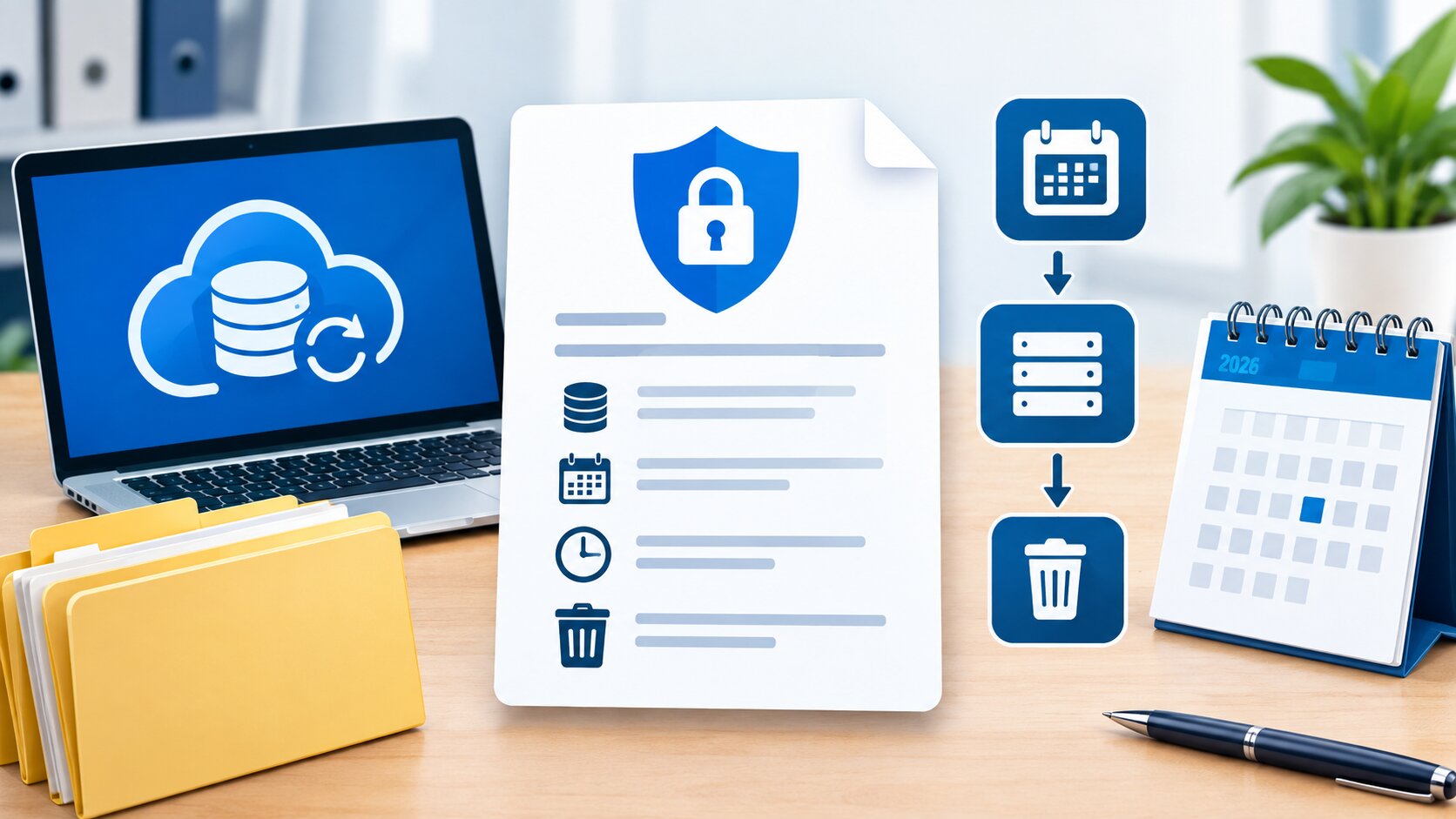
Keeping data forever feels safe, until a breach or an audit makes it a liability instead. A clear data retention policy tells your organization exactly what to keep, for how long, and what to do with it afterward. Here’s how to build one, plus a free template to get started.
Key Takeaways
- A data retention policy defines how long different types of data get kept, and what happens to it afterward.
- Retention periods should be based on legal requirements, business need, and risk, not guesswork.
- Keeping data longer than necessary increases breach exposure without adding real business value.
- A good policy covers storage location, disposal method, and ownership for every data category.
- Retention policy work connects closely to secure data erasure practices and ITAD processes for hardware disposal.
What Is a Data Retention Policy?
A data retention policy is a formal document that defines how long an organization keeps different categories of data, and what happens to that data once the retention period ends. Rather than keeping everything indefinitely, a good policy ties retention periods to actual legal, regulatory, or business justification. Data privacy regulations increasingly require organizations to demonstrate a defined retention rationale, rather than simply retaining data by default. This makes a documented policy a practical necessity, not just a best practice. Related concepts include data classification, legal hold, data minimization, and secure disposal.
In simple terms, a retention policy answers three questions for every type of data your company holds: how long do we actually need this, where does it live, and how does it get destroyed when the time comes?
Why Data Retention Policies Matter
Reduces breach exposure
Data you don’t have can’t be stolen. Every unnecessary record kept past its useful life represents pure risk with no corresponding benefit, since attackers can’t breach data that’s already been properly deleted.
Supports legal compliance
Many regulations specify minimum or maximum retention periods for certain data types. A documented policy demonstrates good-faith compliance efforts during audits or legal proceedings.
Improves storage efficiency
Retaining data indefinitely increases storage costs over time, particularly for organizations managing large volumes of customer or transactional records.
Clarifies responsibility
A clear policy assigns ownership for each data category, so there’s no ambiguity about who decides when data gets deleted, or who’s responsible if it isn’t.
Free Data Retention Policy Template
Use the structure below to start building your own policy. Copy it into a spreadsheet, or download the CSV version linked at the end of this guide.
| Data Category | Retention Period | Legal/Business Basis | Storage Location | Disposal Method | Owner |
|---|---|---|---|---|---|
| Employee records | 7 years post-termination | Labor law compliance | HR system / secure archive | Certified data destruction | HR |
| Financial transactions | 7 years | Tax and audit requirements | Accounting system | Certified data destruction | Finance |
| Customer contracts | Duration + 6 years | Contract/legal liability period | Document management system | Certified data destruction | Legal |
| Marketing email lists | Until opt-out or 3 years inactive | Consent-based (GDPR/CCPA) | CRM/email platform | Secure deletion | Marketing |
| Security/access logs | 1 year | Security monitoring | SIEM/log storage | Automated deletion | IT Security |
These retention periods are common starting points, but always confirm exact requirements with legal counsel, since regulations vary significantly by industry and jurisdiction.
How to Set Retention Periods for Each Data Category
Start with legal requirements
Research the minimum retention periods required by regulations applicable to your industry and location, since these set a firm floor for certain data types.
Layer in business need
Beyond legal minimums, consider how long data actually provides business value. Old marketing data, for example, often loses relevance well before any legal requirement would force its deletion.
Factor in risk tolerance
For sensitive data with limited ongoing value, shorter retention periods reduce risk exposure, even when no specific law requires immediate deletion.
Common Data Retention Mistakes
“The biggest mistake we see is companies keeping everything indefinitely because deleting feels risky. In reality, unnecessary retention is usually the bigger risk. If you get breached, every record you didn’t need to keep becomes part of the exposure.” — Lisa Farrow, Data Governance and Privacy Consultant, Enterprise Compliance Advisory, 2025.
Keeping data “just in case” without a documented reason creates unnecessary breach exposure and compliance risk. On the other end, deleting data too early, before legal retention requirements are met, creates a different kind of liability. Getting retention periods right requires balancing both risks deliberately, which is exactly what a documented policy, paired with secure disposal practices, helps accomplish.
How to Build and Roll Out Your Policy
- Inventory your data categories — List every major type of data your organization collects and stores, from HR records to customer transactions.
- Assign retention periods and legal basis — Work with legal counsel to confirm accurate retention periods for each category based on applicable regulations.
- Define disposal methods — Specify exactly how each data type gets destroyed at the end of its retention period, whether that’s secure digital deletion or physical destruction.
- Assign ownership — Designate a responsible department or role for each data category, so retention and disposal actually happen on schedule.
- Review and update annually — Revisit the policy at least once a year, since regulations and business needs both shift over time.
Frequently Asked Questions
How long should a company keep customer data?
This varies by data type and applicable regulation, but many companies retain active customer data for the duration of the relationship plus several years afterward, based on contractual or tax requirements.
Is a data retention policy legally required?
Requirements vary by industry and jurisdiction, but many data privacy regulations effectively require organizations to justify how long they retain personal data, making a documented policy a practical necessity.
What happens if data is deleted too early?
Deleting data before legally required retention periods end can create compliance violations or hinder legal proceedings, so retention periods should always account for applicable minimum requirements.
Should retention policies cover paper records too?
Yes. A complete data retention policy should address both digital and physical records, since paper documents carry many of the same legal and security considerations as digital data.
How often should a data retention policy be updated?
Most organizations review and update their retention policy annually, or whenever significant regulatory changes occur that affect applicable retention requirements.
Conclusion
A data retention policy turns “keep everything forever, just in case” into a deliberate, defensible practice. By defining exactly how long each data category should be kept, where it lives, and how it gets disposed of, organizations reduce breach exposure while staying compliant with legal requirements. Use the template above as your starting point, then refine it with legal counsel to match your specific industry and regulatory environment.
For related reading, see our guides on secure data erasure, ITAD (IT Asset Disposition), and identity theft prevention.