

Run a network cable near heavy machinery, fluorescent lighting, or a bundle of power cables, and interference can quietly degrade your signal. STP cable exists specifically to solve that problem.
Here’s what makes it different from standard network cabling, and when it’s actually worth the extra cost.
Key Takeaways
- STP (Shielded Twisted Pair) cable adds a metallic shield around its wire pairs to block electromagnetic interference.
- It differs from UTP (Unshielded Twisted Pair), the more common cable type used in most standard installations.
- STP works best in environments with heavy electrical noise, like industrial facilities or dense equipment rooms.
- Proper grounding is essential for STP cable to function correctly, unlike UTP.
- STP often gets installed in IDF closets and other high-interference network spaces where signal integrity matters most.
What Is STP Cable?
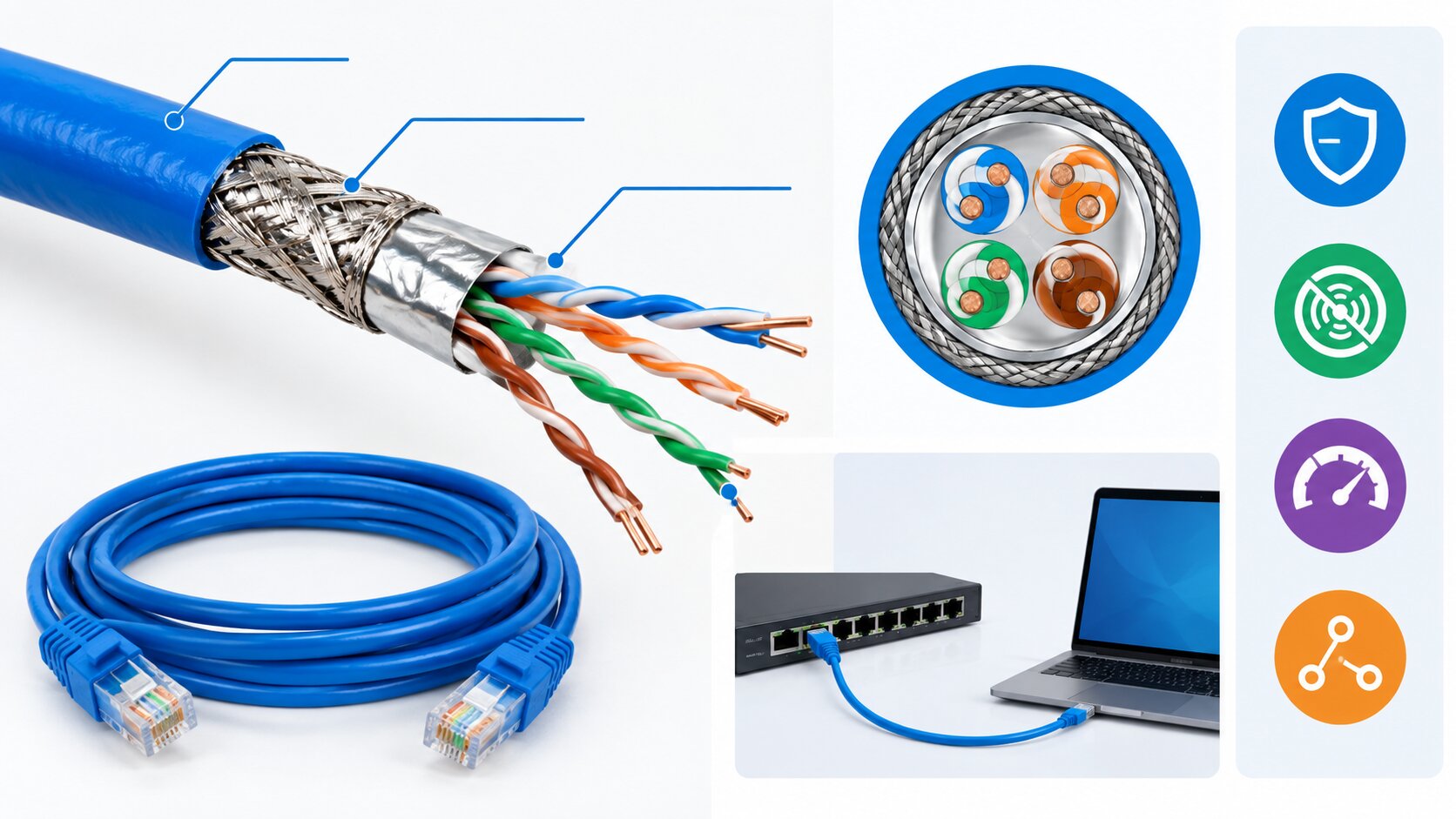
STP, or Shielded Twisted Pair, is a type of network cable that wraps its twisted wire pairs in a metallic shield, typically foil or braided mesh, to block electromagnetic interference (EMI) and radio frequency interference (RFI) from affecting the signal. Structured cabling standards recognize STP as a distinct category alongside UTP, specifically because certain environments generate enough electrical noise to meaningfully degrade unshielded cable performance. Related concepts include UTP (Unshielded Twisted Pair), EMI, crosstalk, and cable grounding.
In simple terms, STP cable is UTP cable with an added layer of protection. That shield acts like a barrier, keeping outside electrical noise from corrupting the data signal traveling through the wires.
How STP Cable Works
STP cable relies on its shielding layer to actively block interference, rather than simply relying on wire twisting alone.
- Shielding layer — A layer of foil, braided mesh, or both surrounds the twisted pairs, physically blocking external electromagnetic interference from reaching the signal wires.
- Individually shielded pairs (in some variants) — Higher-grade STP cable shields each pair separately, in addition to an overall cable shield, further reducing crosstalk between pairs.
- Grounding requirement — The shield only works effectively when properly grounded at both ends. Without correct grounding, STP can actually perform worse than standard UTP.
- Twisted pair design — Like UTP, STP still relies on twisted wire pairs to cancel out some interference through the twisting itself, with the shield adding an additional layer of protection.
STP vs. UTP: What’s the Difference?
UTP is the standard choice for most installations
UTP (Unshielded Twisted Pair) relies solely on wire twisting to reduce interference, without any additional shielding. It costs less, installs more easily, and works well in typical office environments.
STP adds protection for high-interference environments
STP’s shielding layer specifically targets environments where UTP alone isn’t enough, like near industrial equipment, elevators, or dense concentrations of electrical cabling.
The trade-off comes down to cost and complexity
STP costs more than UTP and requires proper grounding to function correctly. Installing it incorrectly, without proper grounding, can actually introduce problems rather than solving them.
STP vs. UTP: Side-by-Side Comparison
| Feature | STP | UTP |
|---|---|---|
| Interference protection | High, due to shielding | Moderate, relies on twisting alone |
| Cost | Higher | Lower |
| Installation complexity | Higher, requires proper grounding | Lower, simpler installation |
| Common use case | Industrial settings, high-EMI areas | Standard office and home networks |
| Cable diameter | Generally thicker | Generally thinner |
When to Use STP Cable
“People often reach for STP automatically, assuming shielded is always better. In a typical office, that extra cost and grounding complexity usually isn’t worth it. STP earns its place specifically where real interference exists.” — Kevin Ortiz, Network Infrastructure Manager, Enterprise Building Systems Group, 2025.
STP makes the most sense in specific environments: near industrial machinery, in facilities with heavy electrical equipment, or in dense equipment rooms where multiple cable types run close together. For standard office cabling, UTP typically performs perfectly well at a lower cost. This decision often comes down during IDF closet design, where cable routing near power infrastructure or industrial equipment can determine whether shielding is actually necessary.
How to Decide Between STP and UTP
- Assess your environment for interference sources — Identify nearby electrical equipment, motors, fluorescent lighting, or power cabling that could introduce EMI.
- Consider cable routing paths — If cabling must run parallel to power lines or through electrically noisy areas, STP becomes more justified.
- Evaluate your grounding infrastructure — Confirm your facility can properly ground STP cable at both ends, since improper grounding negates its benefits.
- Weigh cost against actual risk — For low-interference environments, UTP’s lower cost and simpler installation usually make more practical sense.
- Consult structured cabling standards — Reference TIA/EIA guidelines for your specific application to confirm which cable category and shielding level fits your requirements.
Frequently Asked Questions
What does STP stand for in networking?
STP stands for Shielded Twisted Pair, a type of network cable that adds a metallic shield around its wire pairs to block electromagnetic interference.
Is STP cable always better than UTP?
Not necessarily. STP costs more and requires proper grounding to work correctly. In low-interference environments like a typical office, UTP often performs just as well at a lower cost.
What happens if STP cable isn’t grounded properly?
Improperly grounded STP can actually perform worse than UTP, since the shield can act as an antenna, picking up interference instead of blocking it, when not grounded correctly.
Can STP and UTP cables be mixed in the same network?
Yes, though connecting hardware needs to support the cable type in use, and mixing shielded and unshielded segments requires careful attention to grounding continuity where shielding exists.
Does STP cable cost significantly more than UTP?
Yes, generally. STP cable typically costs noticeably more than equivalent UTP cable, due to the additional shielding material and more complex manufacturing process.
Conclusion
STP cable solves a specific problem: protecting network signals from electromagnetic interference in environments where that interference genuinely exists. For most standard office and home installations, UTP remains the practical, cost-effective choice. But in industrial settings, dense equipment rooms, or anywhere heavy electrical noise threatens signal integrity, STP’s shielding, paired with proper grounding, makes a real difference in network reliability.
For related reading, see our guides on what an IDF is, wide area networks, and what a RAN is.