
Every time a phone gets a signal bar, connects to 5G, or loses a call in an elevator, a RAN is the reason why. It’s the part of the mobile network that almost nobody sees, sitting between a phone and the rest of the internet, yet it decides more about call quality and data speed than anything else in the chain.
Here’s what a RAN actually is, how it works, and why “Open RAN” has become such a big deal in the industry.
Key Takeaways
- A RAN (Radio Access Network) connects end-user devices like phones to the core network using radio signals.
- It’s made up of antennas, base stations, and the equipment that manages the radio connection.
- RAN sits between the device and the core network, working alongside wide area networks to move data over long distances.
- Open RAN is a growing industry shift toward interoperable, multi-vendor RAN hardware and software.
- RAN performance directly affects 5G network features like MCX and other real-time mobile services.
What Is a RAN?
A RAN, or Radio Access Network, is the part of a telecommunications network that connects individual devices — phones, tablets, IoT sensors — to the core network using radio waves. A 2025 GSMA industry report noted that RAN infrastructure typically accounts for the majority of a mobile operator’s total network capital spending, which shows just how central this layer is to building out coverage. Related entities include the base station, the antenna, the core network, and spectrum, all of which work together to move a signal from a device to the wider internet.
In simple terms, if a phone call or data session is a conversation, the RAN is the part of the network doing the actual “listening” and “talking” over the air — everything else happens once that signal has been picked up and handed off.
How a RAN Works
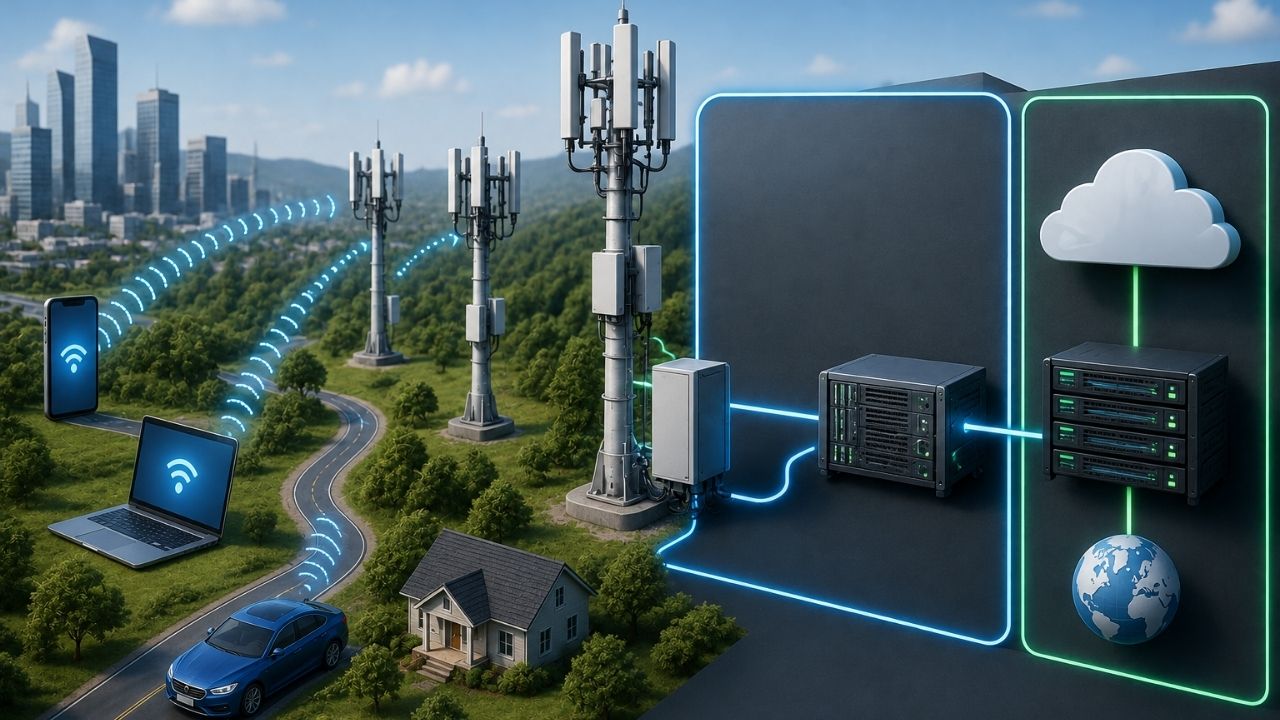
A RAN connects a device to the core network through a short chain of physical and logical steps, each with a specific job.
- User equipment (UE) sends and receives radio signals — this is the phone or connected device itself.
- Antenna picks up and transmits the radio waves over the air interface.
- Base station (gNodeB in 5G, eNodeB in 4G) manages the radio connection, allocates spectrum, and controls handoffs between cells.
- Backhaul link carries the signal from the base station back to the core network, often over fiber or microwave.
- Core network takes over from there, routing data to the internet, other callers, or cloud services.
The Main Types of RAN Architecture
Not all RAN deployments look the same, and the architecture chosen affects both cost and flexibility for the operator.
| RAN Type | Description | Best For |
|---|---|---|
| Traditional RAN | Proprietary, single-vendor hardware and software bundled together | Established operators with existing infrastructure |
| Cloud RAN (C-RAN) | Centralizes baseband processing in a data center, connected to remote radio heads | Dense urban areas needing shared processing capacity |
| Open RAN (O-RAN) | Disaggregated, interoperable hardware and software from multiple vendors | Operators wanting flexibility and lower long-term costs |
| Virtualized RAN (vRAN) | RAN functions run as software on standard servers instead of dedicated hardware | Operators prioritizing scalability and rapid upgrades |
RAN vs. Core Network: What’s the Difference?
The RAN handles the “last mile” over the air
It manages the radio connection between the device and the nearest base station, including signal strength, handoffs between cells, and spectrum allocation.
The core network handles everything after that
Once a signal reaches the base station, the core network takes over authentication, routing, billing, and connecting the call or data session to its destination — whether that’s another phone, a website, or a cloud application.
They depend on each other
A fast RAN with a congested or poorly designed core network still delivers a bad user experience, and vice versa — both layers have to be sized and managed together, similar to how network routing decisions affect performance elsewhere in the stack.
Why Open RAN Matters
“Open RAN is the biggest structural shift the industry has seen since the move to 4G LTE. Operators are no longer locked into one vendor’s hardware and software stack for the entire radio layer.” — Marcus Reyes, VP of Network Architecture, Global Telecom Infrastructure Alliance, 2025.
Open RAN standardizes the interfaces between RAN components so that hardware from one vendor can work with software from another. According to O-RAN Alliance member data published in 2025, over 20 operators worldwide had committed to commercial Open RAN deployments, up sharply from a handful of early trials just a few years earlier. This matters because it can lower costs, speed up innovation, and reduce reliance on any single equipment supplier — echoing broader shifts in telecom history, from analog exchanges to today’s software-defined networks (see our overview of the history of telephony).
Step-by-Step: How a Mobile Signal Travels Through the RAN
- Device connects to the nearest cell — The phone searches for and locks onto the strongest available signal from a nearby antenna.
- Base station authenticates and allocates resources — The base station assigns spectrum and manages the radio link for that session.
- Data or voice is transmitted over the air interface — Information moves between the device and the base station using radio waves.
- Backhaul carries the signal to the core network — The base station forwards the session over fiber, microwave, or other backhaul links.
- Core network completes the connection — The signal is routed to its destination, whether that’s another device, the internet, or a cloud service.
Frequently Asked Questions
What does RAN stand for?
RAN stands for Radio Access Network, the part of a mobile network that connects user devices to the core network using radio signals.
Is RAN the same as 5G?
No — RAN provides the general architecture for 2G, 3G, 4G, and 5G networks, while 5G represents a specific generation of mobile technology that runs on RAN and requires RAN upgrades.
What is Open RAN in simple terms?
Open RAN lets operators combine hardware and software from different vendors in their radio networks instead of relying on one company’s proprietary system.
Why does RAN cost so much for mobile operators?
RAN requires physical infrastructure like antennas, base stations, and towers spread across every coverage area, which is why it typically represents the largest share of a mobile operator’s network capital spending.
Does a weak RAN signal affect internet speed?
Yes — since the RAN is the first hop for any mobile data session, a weak or congested radio connection directly limits the speed and reliability a user experiences, regardless of how fast the core network or backhaul is.
Conclusion
A RAN is the radio layer that connects every phone call and mobile data session to the rest of the network, making it one of the most important — and most expensive — parts of telecom infrastructure. Whether it’s traditional, cloud-based, or Open RAN, the architecture choice shapes coverage quality, upgrade speed, and long-term cost for operators. As Open RAN adoption grows, expect more competition and faster innovation in how signals get from a phone to the internet.
For related reading, see our guides on wide area networks, MCX support in 5G networks, and static vs. dynamic routing.