

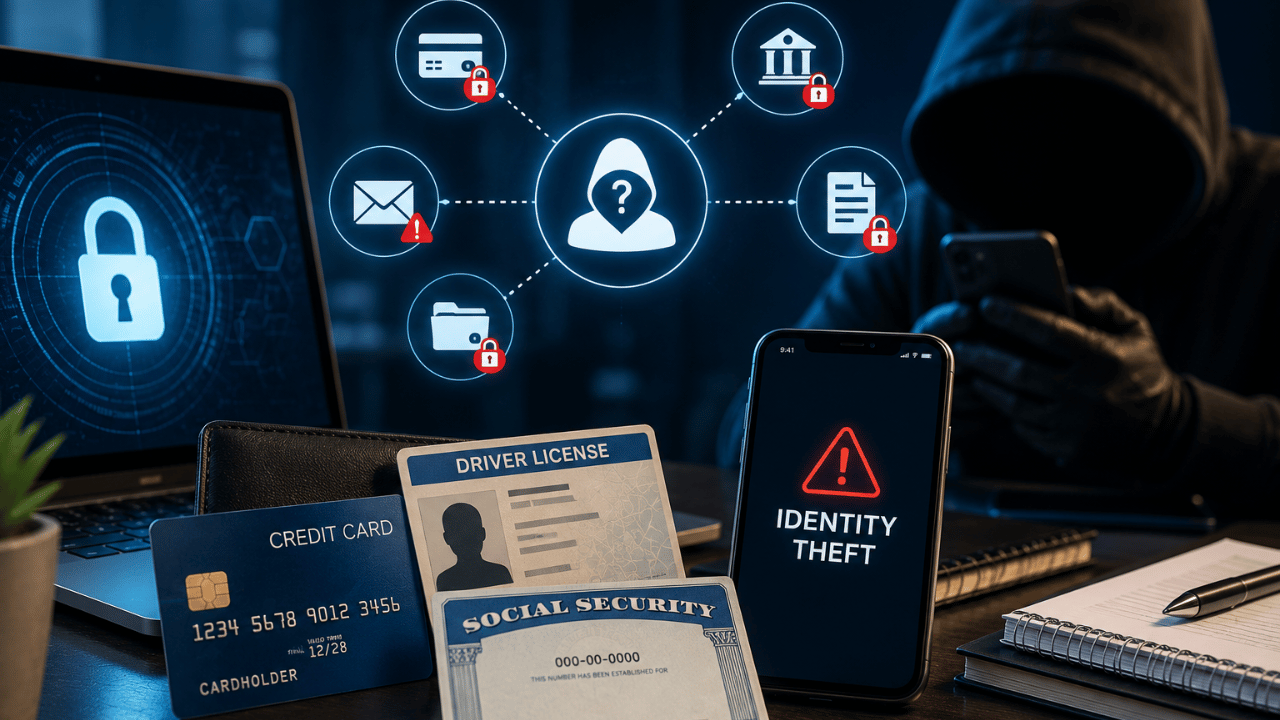
Identity theft can happen anytime, to anyone. Last year alone, more than a million people reported it to the FTC — and that’s likely an undercount, since many victims never report it at all.
The damage goes beyond money. Three-quarters of victims surveyed by the FTC reported severe distress over the misuse of their personal information — and identity theft can affect your ability to get a job, rent an apartment, or get approved for a loan long after the initial fraud occurred.
Here’s exactly what identity theft is, how thieves actually get your information, and the specific steps that meaningfully reduce your risk.
What Is Identity Theft?
The simplest way to define identity theft is: it’s when someone purposefully uses your personal information for illegal gains or to cause harm. It involves the theft of personally identifiable information (PII) — including but not limited to your name, driver’s license details, Social Security number, health records, and biometric data.
Identity theft occurs when someone steals another person’s personally identifiable information and uses it without permission to commit fraud. Fraudsters usually seek details like Social Security numbers or financial information, then use this to open new accounts, make unauthorized purchases, steal tax refunds, or obtain medical services.
This isn’t a rare event. Nearly 750,000 identity theft cases were reported in just the first half of 2025 — and with hacking methods evolving alongside AI, the problem isn’t slowing down.
How Identity Theft Actually Happens
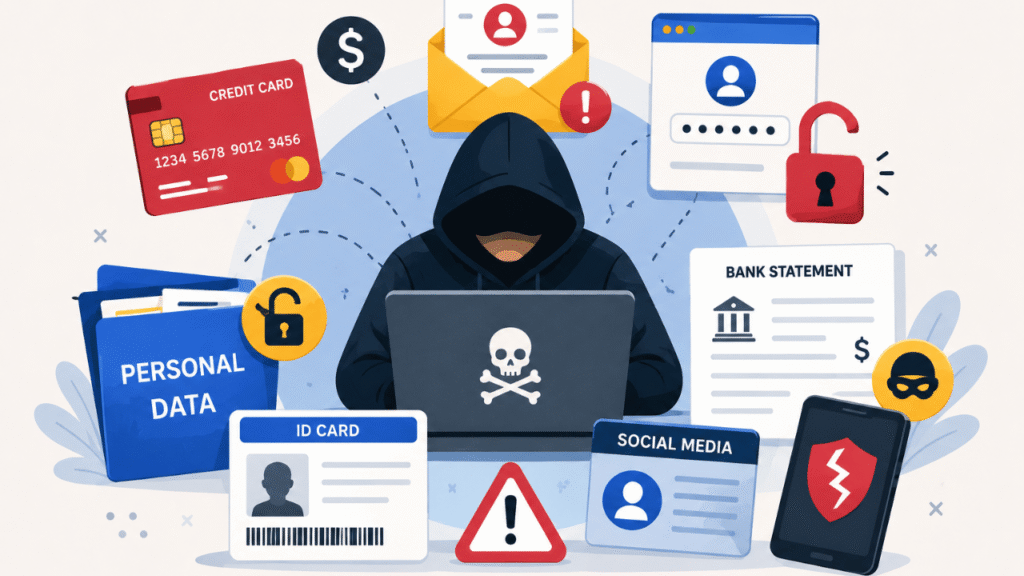
Identity thieves use both old-school and modern methods to steal your information:
Physical theft:
- Stealing wallets or purses containing driver’s licenses, credit cards, and other ID
- Stealing mail that includes bills, tax documents, and bank statements
- Filing a fraudulent change-of-address request with USPS to redirect your mail
- Dumpster diving through trash for discarded documents containing your PII
- Skimming devices placed on credit card machines and ATMs
Digital theft:
- Phishing emails and fake login pages that trick you into entering your information directly
- Data breaches at companies that store your information
- Scraping personal details you’ve shared publicly on social media
- Malware and keyloggers that capture your data as you type
Learn the specific tactics scammers use in emails: What Is Phishing? How to Spot Fake Emails
Synthetic identity theft — the growing threat: This occurs when a real person’s information is stolen and then combined with falsified information to essentially create a new identity. What’s scary about synthetic identity theft is that it’s extremely difficult to detect with conventional fraud monitoring techniques, since the resulting identity doesn’t fully match any single real person’s profile.
Types of Identity Theft You Should Know
Identity theft isn’t one single thing — it shows up in several distinct forms, each requiring different prevention and recovery steps:
| Type | What Happens |
|---|---|
| Financial identity theft | Thief opens credit cards, loans, or bank accounts in your name |
| Tax identity theft | Someone files a fraudulent tax return using your Social Security number to claim your refund |
| Medical identity theft | Your health insurance information is used to obtain medical services or prescriptions |
| Synthetic identity theft | Your real PII is combined with fake details to create an entirely new identity |
| Business identity theft | Criminals use a company’s EIN or business credentials to commit tax fraud or open fraudulent accounts |
| Unemployment fraud | Your Social Security number is used to file a fraudulent unemployment claim |
Warning Signs You May Be a Victim
Catching identity theft early dramatically limits the damage. Watch for:
- Unfamiliar charges on bank or credit card statements
- Bills or collection notices for accounts you never opened
- A bill that doesn’t arrive when expected (a sign your mail may have been redirected)
- Health insurance statements listing claims or charges you don’t recognize
- The IRS rejecting your tax return because one was already filed under your Social Security number
- Being denied credit unexpectedly, with no clear reason
- Receiving notices about unemployment benefits you never applied for
How to Prevent Identity Theft — 8 Proven Steps
1. Freeze Your Credit (The Single Most Effective Step)
The single-most effective thing you can do to prevent identity theft is to freeze your credit with the three major credit bureaus — Experian, Equifax, and TransUnion. When you freeze your credit, you block anyone from gaining access to your credit report, which makes it nearly impossible for anyone to open a new account in your name.
Freezing your credit is completely free and won’t impact your credit score in any way. When you want to open a new account or apply for credit yourself, you can temporarily lift the freeze.
How to do it: Visit each bureau’s website individually (Experian.com, Equifax.com, TransUnion.com) and request a freeze — it takes a few minutes per bureau.
2. Monitor Your Statements Regularly
Read bank, credit card, and health insurance statements often to make sure all charges or claims are familiar. Smart hackers will try to camouflage fraudulent activity so it doesn’t stand out — small, recurring charges are sometimes used to test a stolen card before bigger purchases follow.
How often: At minimum monthly. Weekly is better if you can manage it.
3. Check Your Credit Reports Annually
Review your credit reports annually. You’re entitled to one free report from each of the three major credit bureaus at AnnualCreditReport.com — the only federally authorized source for free credit reports.
Look for accounts you don’t recognize, inquiries you didn’t make, or addresses you’ve never lived at.
4. Shred Sensitive Documents
It’s shockingly easy to give away your PII simply by throwing out a bill without shredding it first. Anyone willing to dig through your trash can find bank statements, pre-approved credit offers, and other documents with your personal details intact.
Shred: Bank statements, credit card offers, tax documents, medical bills, and anything listing your Social Security number.
5. Use Strong, Unique Passwords and Enable MFA
You can massively minimize identity theft risks with consistent cybersecurity best practices like using long, random passwords and enabling multi-factor authentication (MFA).
Since much of modern identity theft starts with a stolen password being reused across multiple accounts, this single habit closes one of the biggest doors attackers rely on.
6. Be Skeptical of Unsolicited Requests for Information
Always question why your Social Security number, birthdate, or other sensitive details are being requested. If it’s not mandatory, avoid sharing it — especially online. Verify the legitimacy of the person or organization requesting your information before responding.
Legitimate companies rarely ask for your full Social Security number over email or phone out of nowhere.
7. Keep Your Devices and Software Updated
Outdated software is a common entry point for hackers. Keep your devices and applications up to date by enabling automatic updates — this ensures you’re protected against the latest known vulnerabilities that identity thieves actively exploit.
Also check your device for active threats: Best Antivirus Software 2026 – Which One Actually Works?
8. Consider an Identity Theft Protection Service
Identity theft protection services monitor your credit (usually with all three bureaus), look at criminal and court records, and monitor for change-of-address requests, payday loan applications, and dark web exposure — detecting potential identity theft before it results in serious financial damage.
These services also help with identity restoration if theft does occur, and many include identity theft insurance — typically offering reimbursement up to $1 million, though usually excluding lost wages or legal fees.
Worth it if: You’ve previously been a victim, you have a complex financial profile, or you simply want ongoing monitoring without checking manually yourself.
Credit Freeze vs. Fraud Alert — What’s the Difference?
Both tools help protect you, but they work differently:
| Feature | Credit Freeze | Fraud Alert |
|---|---|---|
| What it does | Blocks all access to your credit report | Warns lenders to verify your identity before approving credit |
| Cost | Free | Free |
| Duration | Until you lift it | 1 year (extended alert: 7 years for confirmed victims) |
| Best for | Strong, proactive protection | Lighter-touch protection, doesn’t fully block access |
| Inconvenience | Must unfreeze to apply for new credit | Minimal — lenders just verify identity |
Recommendation: If you’re not planning to apply for new credit soon, a freeze offers stronger protection. If you want some monitoring without the hassle of freezing/unfreezing, a fraud alert is the lighter option.
What to Do If You’re a Victim of Identity Theft
If you believe you’ve been a victim of identity theft, it’s important to act quickly to minimize potential damage and try to recover any stolen funds.
Immediate steps:
- Place a fraud alert or freeze with the three credit bureaus immediately
- Contact affected institutions — banks, credit card companies, or healthcare providers where fraud occurred
- Report it to the FTC at IdentityTheft.gov — this generates a personalized recovery plan
- File a police report if needed (especially for larger financial losses)
- Review and dispute any fraudulent accounts or charges with the relevant institution
- Change passwords on all financial and email accounts, and enable MFA
- Monitor your credit closely for the following months for any further suspicious activity
Identity Theft Statistics 2026 — The Scale of the Problem
| Statistic | Figure |
|---|---|
| Identity theft reports filed with FTC annually | 6.4+ million |
| Estimated frequency of new victims | Every 4.9 seconds |
| Cases reported in first half of 2025 alone | ~750,000 |
| Consumers with identity theft protection (2025) | 33% (up from 28% the year prior) |
| Maximum typical identity theft insurance coverage | Up to $1 million |
Frequently Asked Questions
Check your bank and credit card statements regularly for unfamiliar charges, and pull your free annual credit reports from AnnualCreditReport.com to look for accounts you don’t recognize. Signs like unexpected IRS rejections or unemployment notices you didn’t apply for are also strong indicators.
No. Freezing your credit is completely free and does not affect your credit score in any way. It only blocks new creditors from accessing your report — your existing accounts and credit history remain unaffected.
Synthetic identity theft occurs when a real person’s stolen information is combined with falsified details to create an entirely new identity. It’s particularly dangerous because it’s extremely difficult to detect using conventional fraud monitoring, since the new identity doesn’t perfectly match any single real victim’s profile.
No — it’s impossible to completely prevent identity theft, since some risk factors are outside your control (such as a company you trust suffering a data breach). However, consistent habits like freezing your credit, monitoring statements, and using strong passwords with MFA dramatically reduce your likelihood of becoming a victim.
It depends on your risk profile. These services typically offer reimbursement up to $1 million for identity theft-related losses, though usually excluding lost wages or legal fees. If you’ve previously been a victim or want professional help with monitoring and recovery, it can be worthwhile.
Immediately place a fraud alert or freeze with the three credit bureaus, then report the theft at IdentityTheft.gov for a personalized recovery plan. Contact any affected financial institutions directly, and change passwords on your accounts while enabling multi-factor authentication.
Conclusion
Identity theft is a numbers game for criminals — they’re targeting volume, not individuals specifically. That means the basic habits in this guide — freezing your credit, monitoring statements, shredding documents, and using strong passwords with MFA — meaningfully shift the odds in your favor.
Start with these three today:
- Freeze your credit with all three bureaus
- Pull your free annual credit reports and review them
- Enable multi-factor authentication on your email and financial accounts
None of these cost money, and together they close the majority of common identity theft pathways.
→ Also read: