

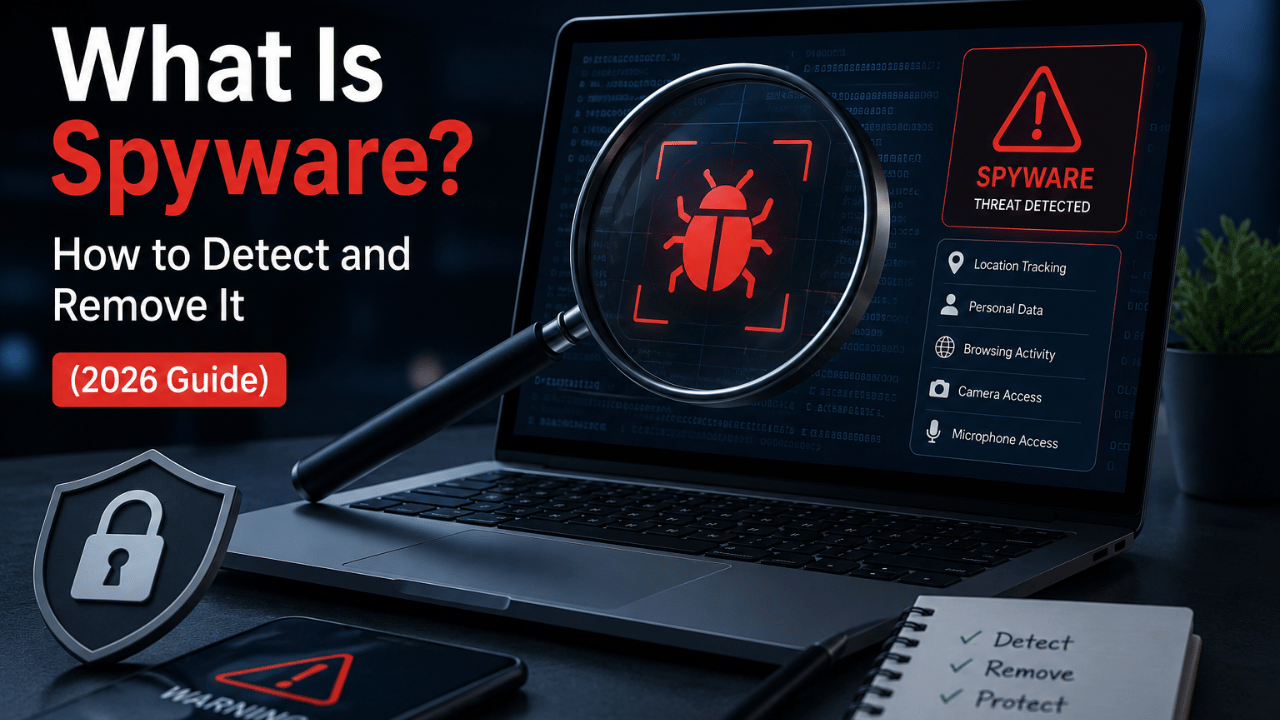
Your device can be spied on right now — and you might have no idea it’s happening.
Spyware is malicious software designed to infiltrate and monitor your computer, smartphone, or tablet without your knowledge or consent. It discreetly runs in the background, collecting data such as your browsing history and passwords and even taking control of your device’s camera or microphone.
The consequences range from privacy violations and financial loss to identity theft. Here’s exactly what spyware is, how to spot it, and how to remove it completely.
What Is Spyware?
Spyware is malware that secretly installs on your device to collect information like browsing activity, passwords, and payment data. It operates silently in the background and is difficult to remove once installed.
Unlike ransomware (which announces itself) or viruses (which cause damage), spyware’s entire purpose is to remain invisible. The longer it stays hidden, the more data it collects. Some spyware variants can even activate your device’s camera or microphone — turning your own hardware into a surveillance tool.
This data is then sent to a third party, such as hackers, advertisers, abusive partners, private investigators, or even governments.
Your passwords captured by spyware can lead directly to identity theft: What Is Identity Theft? How to Prevent It in 2026
Types of Spyware
Not all spyware works the same way. Understanding the types helps you recognize what you might be dealing with:
| Type | What It Does |
|---|---|
| Password Stealers | Captures login credentials as you type them |
| Banking Trojans | Intercepts financial transactions and banking credentials |
| Infostealers | Harvests stored passwords, cookies, and autofill data from browsers |
| Keyloggers | Records every keystroke — including passwords and messages |
| Adware | Displays intrusive ads and tracks browsing behavior for targeting |
| Stalkerware | Used by abusive partners to track location, messages, and calls |
| System Monitors | Captures screenshots, records calls, and monitors all activity |
Some extreme, invasive versions of spyware may track exactly what keys you type.
Keyloggers are a specific spyware type with their own detection method: What Is a Keylogger? How to Detect One on Your PC
How Spyware Gets on Your Device
Spyware spreads through exploits, phishing, misleading downloads, software bundles, Trojans, and malicious mobile apps.
The most common infection routes:
1. Phishing emails and fake downloads You receive an email with an attachment or link. You click it. A spyware installer runs silently in the background while you see nothing unusual on screen.
2. Software bundles (bundleware) Free software downloaded from unofficial sources often includes spyware bundled into the installer — pre-checked boxes that most people skip past without reading.
3. Malicious browser extensions Spyware is known to sometimes install browser extensions and add-ons that monitor every website you visit and capture form data including passwords.
4. Unsecured public WiFi Spyware breaches on smartphones commonly occur through unsecured free WiFi, which is common in public places such as airports and cafes. If you log onto an unsecured network, the bad guys can see everything you do while connected.
Always use a VPN on public networks: Is Free WiFi Safe? Risks and How to Protect Yourself
5. Operating system vulnerabilities Operating system flaws open up exploits that could let attackers infect a mobile device. This is why keeping your OS updated is non-negotiable.
Warning Signs Your Device Has Spyware
Spyware can be subtle, but common indicators include unexpected slowdowns, unusual network activity, browser redirects, new toolbars or extensions you did not install, frequent pop-ups, changed homepage or search engine, unexplained logins on accounts, and unauthorized programs launching at startup.
On PC — watch for:
- Browser homepage changed without your permission
- New toolbars or extensions you never installed
- Increased CPU or memory usage with no obvious cause
- Antivirus or security settings being disabled automatically
- Sluggish performance that gets worse over time
On Android — watch for:
- Battery draining faster than usual
- Unexpectedly high mobile data usage
- Phone getting hot even when idle
- Apps you don’t remember installing
- Strange background noise during calls
On iPhone — watch for:
- Unusual battery drain
- Data usage spikes
- Phone acting slow despite having storage available
- Unfamiliar apps appearing
Important: Advanced security or anti-malware software can detect spyware. If you’ve noticed your computer or phone behaving differently — such as running slowly or displaying unusual or especially intrusive pop-ups — run a scan to identify and remove the threat.
How to Detect Spyware on Your PC — Step by Step
Step 1 — Check Running Processes
Check running processes and CPU usage for persistent, unknown items and monitor outgoing network connections for suspicious hosts. If you notice multiple indicators together, treat the system as potentially compromised and begin containment.
How to do it:
- Press Ctrl + Shift + Esc to open Task Manager
- Click More Details to see the full process list
- Look for processes consuming high CPU or memory that you don’t recognize
- Right-click any suspicious process → Search online to verify
Step 2 — Review Installed Programs and Browser Extensions
Review installed programs: Check your list of installed programs and browser extensions for anything unfamiliar or suspicious. Spyware can sometimes disguise itself as legitimate software. If you spot something you don’t recognize, uninstall it.
Check browser extensions:
- Chrome: Settings → Extensions
- Firefox: Add-ons Manager
- Edge: Extensions menu
Remove anything you don’t remember installing or that has very few reviews.
Step 3 — Run a Full Security Scan
Run a security scan: Use antivirus software to scan your device. The scan will help detect and remove any spyware or other malware.
Recommended free tools:
- Malwarebytes Free — excellent spyware-specific detection
- Windows Defender — built into Windows, good baseline protection
- Spybot Search & Destroy — specialized anti-spyware
Find the best paid protection: Best Antivirus Software 2026 – Which One Actually Works?
Step 4 — Boot Into Safe Mode for Stubborn Spyware
Safe Mode limits active processes, which helps scanners and manual removal tools remove stubborn components that resist deletion during normal operation.
How to enter Safe Mode on Windows:
- Press Windows + R → type
msconfig - Click Boot tab → check Safe Boot → Minimal
- Click Apply → Restart
- Run your antivirus scan in this mode
Step 5 — Use a Rescue Disk for Severe Infections
A rescue disk is a bootable antivirus environment used to scan and clean systems offline. Use it when rootkits are suspected or when in-system scanners cannot remove threats.
Kaspersky Rescue Disk and Bitdefender Rescue Environment are two free options that boot from USB to scan your system completely offline.
How to Remove Spyware — Complete Process
If found via antivirus scan: Most reputable security software quarantines and removes spyware automatically. Run a full scan rather than a quick scan — spyware often hides in locations quick scans skip.
If found manually:
- In Task Manager — right-click the suspicious process → End Task
- Go to Apps & Features → find and Uninstall the related program
- Check Startup apps (Task Manager → Startup tab) — disable anything unfamiliar
- Run a follow-up antivirus scan to confirm removal
After removing spyware: Change passwords from a known clean device and enable multi-factor authentication for critical accounts to reduce the risk of reused or stolen credentials.
Set up MFA properly: What Is Two-Factor Authentication? Complete Setup Guide
How to Detect Spyware on Android
Android devices are particularly vulnerable because of the open nature of the operating system.
Steps to check:
- Go to Settings → Apps — look for unfamiliar apps, especially those with device administrator access
- Check Settings → Battery — see which apps are consuming unusual battery
- Go to Settings → Data Usage — identify any app using unexpected mobile data
- Install Malwarebytes for Android (free) and run a scan
Special concern — stalkerware: Stalkerware is a specific type of spyware often installed physically by someone with access to your device. If you suspect this, the Coalition Against Stalkerware (stopstalkerware.org) has specific guidance for this situation.
How to Detect Spyware on iPhone
iPhones are generally more secure due to Apple’s closed ecosystem, but they’re not immune — especially if the device has been jailbroken.
Check for spyware on iPhone:
- Go to Settings → Privacy & Security → Location Services — review which apps have location access
- Check Settings → General → VPN & Device Management — look for unknown profiles
- Review Settings → Battery for unusual consumption patterns
- Update iOS immediately if you’re running an older version
Important: Some spyware programs are installed by someone who has physical access to your phone, while others are downloaded and installed because you visited a certain website or clicked on an unsafe link.
Spyware vs. Other Malware — What’s the Difference?
| Type | Primary Goal | Visible to User? |
|---|---|---|
| Spyware | Silent data collection | ❌ Designed to hide |
| Ransomware | Extortion via file encryption | ✅ Announces itself |
| Virus | Replicate and damage files | ⚠️ Often causes crashes |
| Adware | Display ads, track browsing | ⚠️ Pop-ups visible |
| Keylogger | Record keystrokes | ❌ Designed to hide |
| Trojan | Create backdoor access | ❌ Disguises itself |
How to Protect Yourself From Spyware
1. Keep software and OS updated Most spyware exploits known vulnerabilities in outdated software. Automatic updates close these windows before attackers can use them.
2. Only download from official sources Avoid third-party download sites for software — use official app stores and manufacturer websites only.
3. Read installation screens carefully Bundled spyware is almost always disclosed in fine print during installation. Uncheck any pre-selected additional software offers.
4. Use a reputable antivirus with real-time protection Real-time scanning catches spyware at the point of entry rather than after infection.
5. Be cautious with email attachments
Learn to spot dangerous emails before clicking: What Is Phishing? How to Spot Fake Emails
6. Use strong, unique passwords If spyware does capture one password, unique passwords for every account limit the damage to a single account.
Frequently Asked Questions
Spyware is a type of malware that hides on your device, secretly recording information and tracking your online activity. It can infect any device, giving people full access to your sensitive information like passwords, banking details, or even your digital identity. It operates silently in the background, sending this data to a remote attacker.
Common indicators include unexpected slowdowns, unusual network activity, browser redirects, new toolbars or extensions you did not install, frequent pop-ups, changed homepage or search engine, unexplained logins on accounts, and unauthorized programs launching at startup.</cite> Run a full antivirus scan to confirm.
Windows Defender can detect and remove many spyware variants, especially when definitions are up to date, but combining it with a second opinion scanner increases detection coverage. Malwarebytes Free is an excellent complement to Windows Defender.
No. A virus replicates and damages files — it often makes itself known through crashes and errors. Spyware’s purpose is the opposite: to remain completely invisible while silently collecting your data. Both are malware, but they behave very differently.
Yes, though less commonly than Android. iPhones are more secure due to Apple’s closed ecosystem, but sophisticated spyware like Pegasus has successfully targeted iPhones. Jailbroken iPhones are significantly more vulnerable. Keep iOS updated and avoid installing apps from outside the App Store.
Conclusion
Spyware is uniquely dangerous because it works best when you don’t know it’s there. Unlike ransomware or viruses that announce themselves through visible damage, spyware’s success depends entirely on staying hidden — quietly harvesting your passwords, financial details, and private communications for as long as possible.
Do these three things today:
- Run a full Malwarebytes scan right now — it’s free
- Check your browser extensions and remove anything you don’t recognize
- Enable real-time antivirus protection if you haven’t already
These steps take under 20 minutes and protect against the vast majority of spyware currently circulating.
→ Also read: