

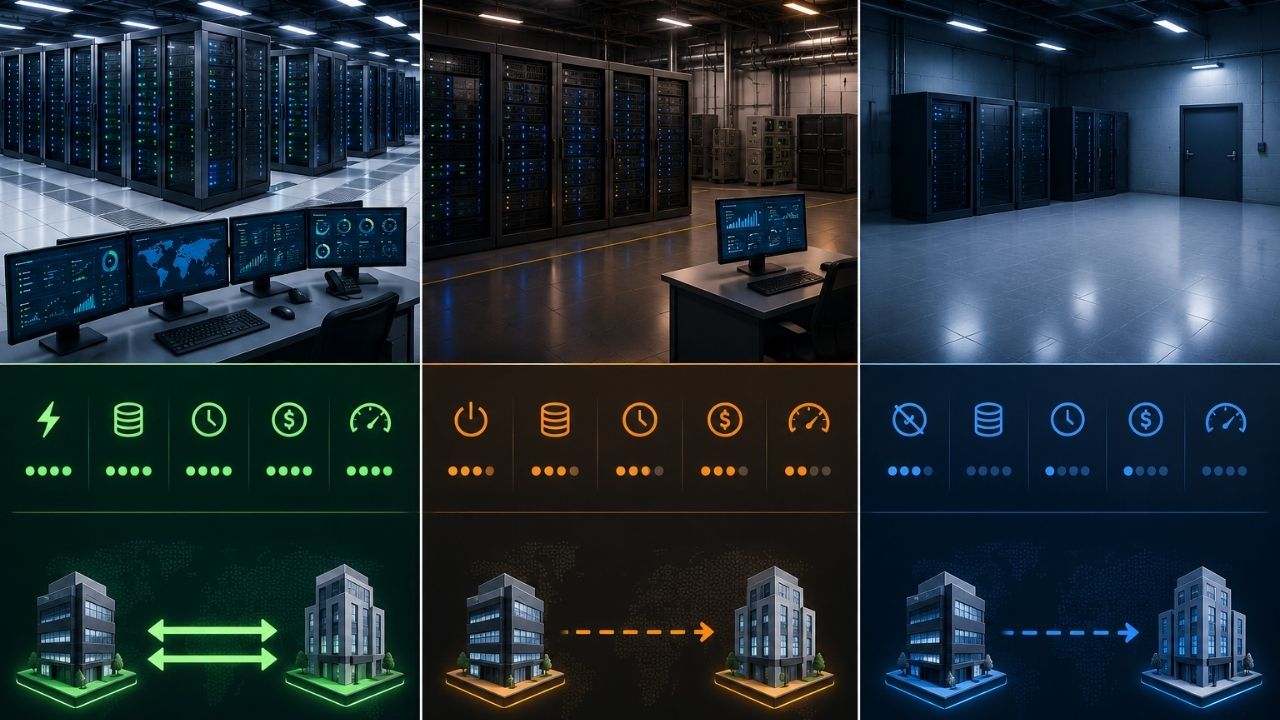
The primary data center goes dark. Flood, fire, or a power grid failure takes it out. What happens next depends on a decision made months earlier: what type of disaster recovery site is in place. Hot, warm, and cold sites represent three very different bets on cost versus recovery speed.
Here’s how to tell them apart, and how to pick the right one for your business.
Key Takeaways
- A hot site is a fully operational backup facility that can take over almost instantly after a disaster.
- A cold site is an empty facility with basic infrastructure but no active systems. It needs significant setup time.
- A warm site sits in between. It’s partially configured and ready to come online faster than a cold site, but cheaper than a hot site.
- Your Recovery Time Objective (RTO) and budget should drive the choice, not just company size.
- All three site types depend on core infrastructure like UPS systems and HA architecture to actually deliver on their recovery promises.
What Is a Disaster Recovery Site?
A disaster recovery (DR) site is a secondary facility your business can switch to if the primary data center or office goes down. Downtime is expensive — mid-size and large enterprises often lose thousands of dollars per minute during an outage. That’s exactly why choosing the right DR site type carries such a direct financial impact. This decision connects to a few key concepts: Recovery Time Objective (RTO), Recovery Point Objective (RPO), business continuity planning, and data replication.
The three main site types — hot, warm, and cold — differ mainly in how “ready to go” they are the moment disaster strikes. And that readiness comes at a cost.
Hot Site: Instant Failover, Highest Cost
A hot site is a fully equipped, continuously running duplicate of your primary environment. Data replicates in near real-time, so operations can fail over almost immediately.
- Recovery time: Minutes to a few hours.
- Cost: Highest of the three options. It requires duplicate hardware, software licensing, and staff running continuously.
- Best for: Businesses where even a few minutes of downtime causes real financial or reputational harm — think financial services, healthcare systems, and critical infrastructure operators.
Cold Site: Lowest Cost, Slowest Recovery
A cold site is a basic facility with power, cooling, and space available. But it has no pre-installed servers, software, or current data. Everything gets set up from scratch after a disaster hits.
- Recovery time: Days to weeks.
- Cost: Lowest of the three. There’s no active equipment or ongoing data replication to maintain.
- Best for: Organizations with a high tolerance for downtime, or those using a cold site purely as a low-cost insurance policy against worst-case scenarios.
Warm Site: The Middle Ground
A warm site sits between the two extremes. It has some hardware, network connectivity, and infrastructure already in place. Data updates periodically, not in real time, so you can bring it fully online faster than a cold site without the continuous cost of a hot site.
- Recovery time: Typically hours to a day or two.
- Cost: Moderate. It costs more than a cold site, but a fraction of what a hot site requires.
- Best for: Mid-size businesses that need reasonably fast recovery but can’t justify the ongoing expense of a fully duplicated hot site.
A warm site typically includes racked servers and network equipment that stay powered on but don’t run production workloads. Data backups update on a regular schedule, hourly or daily, rather than continuously.
Hot vs. Warm vs. Cold Site: Side-by-Side Comparison
| Feature | Hot Site | Warm Site | Cold Site |
|---|---|---|---|
| Recovery time | Minutes–hours | Hours–1-2 days | Days–weeks |
| Data currency | Real-time replication | Periodic backups (hourly/daily) | Outdated or none |
| Equipment on-site | Fully installed and running | Partially installed | Minimal or none |
| Relative cost | Highest | Moderate | Lowest |
| Ongoing staffing | Continuous | Periodic maintenance | Minimal |
| Best fit | Mission-critical operations | Balanced cost/recovery needs | High downtime tolerance |
How to Choose the Right DR Site Type
Start with your Recovery Time Objective (RTO)
Your maximum acceptable downtime should drive this decision more than anything else. If your RTO is measured in minutes, only a hot site realistically meets it.
Factor in your Recovery Point Objective (RPO)
How much data loss can you tolerate? This matters too. A warm site’s periodic backups may mean losing hours of data, while a hot site’s real-time replication minimizes that gap.
Match the budget to actual risk
Not every system needs hot-site protection. Many organizations take a tiered approach instead. They put mission-critical systems on a hot site, then move less critical systems to a warm or cold site.
Consider hybrid and cloud-based options
Cloud-based DR services have made “warm site” capabilities more accessible to smaller organizations. Providers can offer partially provisioned, on-demand infrastructure without the cost of a dedicated physical facility. This approach ties closely to broader on-demand computing models.
Why This Decision Matters
“The biggest mistake we see is companies choosing a DR site type based on cost alone, without mapping it back to what an hour of downtime actually costs their business. A warm site is often the right balance, but only if the RTO math actually supports it.” — Rachel Kim, Business Continuity Director, Enterprise Resilience Partners, 2025.
Choosing the wrong DR site type only becomes visible during an actual disaster. By then, it’s too late to upgrade. Every site type also depends on the same underlying infrastructure fundamentals to work as intended. That means reliable power through a properly sized UPS, and an overall design built around high availability rather than treating DR as a one-time checkbox.
Frequently Asked Questions
What is a warm site in disaster recovery?
A warm site is a partially equipped backup facility. It has some hardware and network infrastructure already in place, plus periodically updated data backups. This allows faster recovery than a cold site, without the full cost of a hot site.
Is a warm site cheaper than a hot site?
Yes. A warm site generally costs significantly less than a hot site, since it doesn’t require continuous real-time data replication or fully duplicated, always-running production infrastructure.
How fast can a warm site be brought online?
Most warm sites can go operational within hours to a couple of days. Some infrastructure is already in place, so it only needs final configuration and the most recent data restored.
Can a business use more than one DR site type?
Yes. Many organizations use a tiered strategy. They assign mission-critical systems to a hot site, then move less critical systems to warm or cold sites. This balances cost against actual business risk.
Do cloud services count as a warm site?
Sometimes. Cloud-based disaster recovery can function like a warm site when infrastructure is partially provisioned and ready to scale up on demand. It offers similar recovery speed without owning a dedicated physical facility.
Conclusion
Hot, warm, and cold sites each represent a different trade-off between recovery speed and cost. The right choice comes down to how much downtime your business can actually absorb before it becomes a serious problem. A warm site often hits the sweet spot for organizations that need faster recovery than a cold site, without committing to the ongoing expense of a hot site. Just ground the decision in a real RTO and RPO analysis, not guesswork.
For related reading, see our guides on UPS power supply fundamentals, what high availability (HA) means, and on-demand computing.